A Remarkable Australian Basket Maker

I have wanted to talk about an extraordinary basket maker in Australia for some time now. Judy Gray-Gardner. In the above picture there are five of her small pieces that she gave to me a very long time ago. It was so generous of her and I would seek her out whenever attending a basket conference over there just to see what she was up to. Sometimes we would sit and weave together and other times she would show me a technique.

I will talk about each of the five pieces and what I remember about them in a bit but first to the other things on the shelf. The assemblage next to the basket box (which is actually an old drawer) was made by a charming man who bought a church in Campbelltown, Tasmania and turned it into a restaurant. I don’t think it is still a restaurant but when he owned it he collected bits and pieces to make into art. There is a fairy penguin bone perched atop a bit of wood, some bit of leather with eyelets, a bit of barn wood with an old brooch of turquoise pieces on brass. He was grey-haired, bearded as I recall, a good cook, and charming so how could I not purchase an artwork of his to stuff in the suitcase.

Below that piece is a student’s clay olive bottle. I bought it from him at a student show at Arrowmont more than ten years ago. Never used it for oil but keep it next to this gourd voodoo basket from Africa. All the beads on strings jiggle when you pick it up and when opened reveal all the strings hanging inside.  I bought it at a fiber conference for my daughter and when I gave it to her I said, “It’s a voodoo piece. Let’s write the name of someone we don’t like on a piece of paper and put inside then give it a good shake at midnight. In the morning we will give them a call and see how they are feeling.” Her response…..”Why don’t you just keep it, mom.”  I never did try that exercise but with our present white house occupant, I might reconsider.

Other pieces in the box are Toni Rogers’ sticks with burned patterns. These were the first ones I acquired as a gift and bought several more from her over the years. Toni is another wonderful artist using natural fibers in her work. Other than those sticks it is just a magnolia pod and some driftwood.

So now back to Judy.

I know, I know there is quite a bit of dust on these. But I do not let my cleaning lady take them out and I really did not see how much dust there was until I moved the photos from my iphone to here. So just overlook it. This one I always thought she told me was rosemary. Maybe in the middle. It no long smells of anything but maybe dust. But what I like about her technique here is this grass looking crochet type of lashing in different directions to hold it all together.

And this random woven vine ball.

And coiled jacaranda stems. Judy’s stitches are so even and I think it took a bit of strength to keep this shape and control over those stems. Here is the other end that might be the starting point.
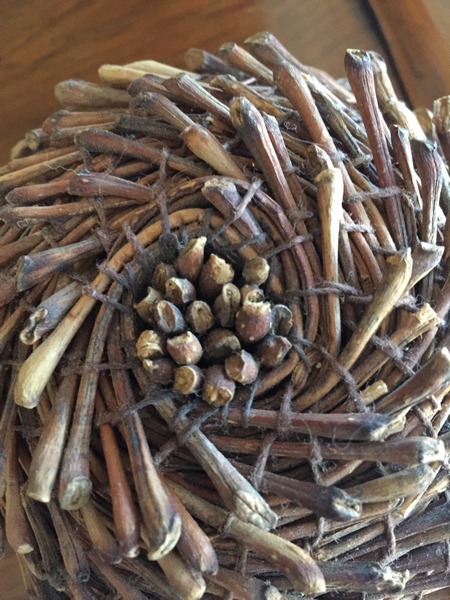
And a coiled corn husk ball. Again look at those even stitches.

And my favorite, a red hot poker boucle coiled piece.

You can see that same cord lashing the coils together. Judy showed me how to make this boucle cordage at a basket conference in Tasmania. We had set aside some time for her to show me and she had the red hot poker stems all soaked and ready. With two pieces of the wet leaf in your left hand held tight with the thumb and forefinger, you use the right hand to twist away from you and before you cross it over to the left and pick up that part with your right, you over twist until it turns back on itself. Brilliant! It takes quite a bit of the leaves to do this as it is curling back on itself, but I love the look of it. And it would have taken so much time for her to make the materials for this small ball that is so much fun to hold in your hands.

The last time I experienced Judy’s generosity was when my daughter (same one who declined ownership of the voodoo basket) and I stayed with her in Adelaide. Judy showed us how to eat big lumps of avocado on wheat toast and call it breakfast. With her friendly neighbors Judy taught us how to play Hoy. It was a game with cards or bingo bits, I don’t remember exactly because it was twelve years ago. But the best part was if you were the winner, you got chocolate and if you were one of the many losers, you got hard candy, or lollies as they say over there. How fun is that!

Anyway, I just wanted to show Judy’s work and say how much I love these pieces and her generosity in just insisting I take them. And her time showing me how to do something with basket materials. I will not be attending the National Basket Conference in South Australia this year. It will be near Adelaide and if anyone sees Judy there, please give her my best. And if she has left this world to gather materials somewhere else…..well, she was certainly one of the best that was on offer down under.

Til next time.

Weaving Grasses

In attempting to clean out storage areas two months ago I came across bundles of sweet grass dating back to the early eighties. Back then at the Michigan basket conferences some Native Americans from Maine would arrive selling their sweet grass. The smell of this was simply divine. I used mine very sparingly on small coiled baskets or inserted into inner and outer rims on splint baskets….especially those having to do with sewing.

In the above picture are two coils of my attempting to ply the sweet grass into cordage. Both thumbs protested after about one hour in the tight gripping and twisting action necessary to hold a good ply. I used the shorter of the sweet grasses that I harvested myself in Michigan or out in Washington state many years ago.

I found another bag full of this shorter one tucked into the studio near some shed snake skins. What in the world am I going to do with those!

Anyway, Here is one of the small sweet grass baskets I made from looking at a Native American sewing accessory. The ring fits over the wrist so that the “ball” that holds the yard is not dropped. The thread to be used is kept inside the ball that is latched shut. The thread feeds out the small hole in the upper part of the ball.

I had braided the sweet grass to use as the weaving element over cane spokes. The rims are lashed with cane as well. I think cane must have been the only small pliable material I had back then. Native Americans used ash splints for their spokes/lashing.

A loop of braided sweet grass came off of the rim from one half of the ball and looped over a knot of sweet grass on the other half to keep the sewing ball closed. I thought this was a rather ingenious way of keeping small balls of threads/yarns close to what you were crocheting/knitting/wrapping. I made only one….who would ever need more?

Here is another small basket I wove with the sweet grass.

You can tell it is small by the anise pod on top for a handle. It is a wonky little thing but I am sure that at the time I was more than a little pleased that I could make a lid that fit over the top.

So it is the eighties remember, hay day of craft experimentation.  Here is what good coiling is supposed to look like. The Gullah baskets of Henrietta Snype. This one I bought from her during a demonstration she was giving on Gullah work.

She uses the sweet grass harvested on the coast of South Carolina and it is much coarser than the sweet grasses of the northern United States. The darker parts here are pine needles for contrast and the palmetto fronds are prepared and sized to be used as the lashing material. She gave me some to try back in 1992 when she was demonstrating and I still have them!

The lighter sweet grass in the picture below is the sweet grass from Maine and was the one I used for the small sewing basket and coiled piece. It is on the left and one and a half times longer and more uniform in shape and size than the grass harvested in Michigan and Washington.

I would also use these grasses in baskets made on the loom.

That one in the top picture from an article I wrote was woven using a popular overshot pattern…Johann Speck’s #33 to be exact. The pattern weft was the sweet grass. The warp was a fine mercerized cotton. The rims were hand peeled ash from log pounding with a tribe native to Michigan. Finished it is 24″ x 16″ x 16″. It smelled wonderful.

Here is another small sample of using the grasses on the loom.

And the last one done about eight years ago going all out making connecting covers for a “Nature Journal”.

Collected grasses from here, pine needles saved from the nineties and palm inflorescence.

When the sweet grass was dampened the smell was wonderful. My grass and my nose are older. When I finished due to sore thumbs the other day, my fingers looked like I took up rolling my own. The stains are still there.

If I could I would pack the whole lot up and take it to basket making friends in Australia. But I can’t. I don’t know many basket makers any more so maybe I am stuck with warping up the loom in the studio and making a very long table runner.

It most certainly will not be warped at twenty plus threads to the inch….my eyes have aged at the same rate as my thumbs and nose.

Here is how all the hand peeled spints ended up.

Sure I used up all the splints and more, but I still have the eight foot boat. I am not sure I have got the hang of downsizing. Maybe a match really is the answer.

Til next time

Just Thinking, Just Talking, Just…….

The silver point drawing did not work….the surface is too rough. But the watercolors hold a line on the gessoed surface. I am just picking up things at random around the studio. Things small enough to sit in front of me. This is the first twelve inches and so far stick of willow, a rock, a cork, an awl that I use for etching, an irresistible little bamboo brush and a stone clothed in cane toad hide with a strip of rawhide. I had to tell myself to stop or the whole five feet would be filled in one day.

When I finish this strip I will roll it up into a bottle and cork it with the addition of wax. Then I will have to find someone to put it in the ocean for me. It would do little good to drop it in a creek or body of water in western North Carolina where it would smash against a rock and ruin the images as it returned to paper pulp. No, I need the ocean. I need to know it took time to get somewhere.

But in the meantime I will keep making these scrolls of the bits of things of my life…my artist life. And one day they will ride a wave to shore and someone will see a bit of me when I needed to remind myself of who I am.

And, please do not tell me that the ocean is full of the unwanted already. I don’t want to hear it. The wine bottle will turn into beach glass and the scroll of images will feed the imagination of the finder. There will not be any contact information on the scroll, but maybe a story of why. It is the one small piece of magic that I can do for now. Isn’t that enough for anyone?

I put that picture in there because no one wants to just look at words. And I needed to change the subject.

Here is a message and my response from this week regarding the last blog.

 “You write so beautifully. I feel like you’re just talking to me.”

 “Thank you, actually it is because I really do not have someone on a daily basis to talk to so the blog helps me have a conversation on what it is I think about or remember, or need to say “out loud”. And besides there are no interruptions when I am talking…a one way conversation! If someone is painfully “listening”, I do not see it on their face….I don’t see them waiting to get a word in edgewise.”
And here is another thing I wrote this week in response to Robyn Gorden’s post of poetry and pictures.
The poem:

When the things you did not ask to happen
have placed a heavy burden
on your heart and mind
it is okay to take time
to rest and to breathe
practicing the art
of surrender,
the bravery
of trusting,
for this, right here,
is peace in uncertainty.
It is not acting as though
the unknown does not exist,
but it is finding freedom
from the fear
and disturbance of it,
knowing well within the soul
the unknown is still unknown,
but it has no hold on you
it has no hold on the present moment,
you are still free
to rest and breathe here.
– Morgan Harper Collins

And my response:

 “I wake early and at 4:30 in the morning I read this post, these words, see these pictures. Already fresh from bed, I try to breathe and rest. Then I glance into my rear view window and see me there, standing on the side of the road, the me that was me just months ago, and find it hard to speed away. I want so bad to go back and give her a lift. More rest and a breath away from such longing is hard to do. But thank you for a place to start.”

It has been a contemplative week. The dreary days, the waiting for something that I have no idea about, the looking up the driveway and then wishing I hadn’t. We all have days like that. And if we don’t, we should. Someone needs to just remind us once in awhile that we need to just rest and breathe, rest and breathe.

And more pictures for the patient reader while I get on to planning my trip to Australia and thinking of their bright warm sunny days and sunny students. I need to get on with applying for my visa to teach there. I need to check on my hotel in Melbourne. I need to get a box of interesting things in the mail to Australia to avoid having to haul them through airports.

I am good. I have a smile on my face now. Here are some pictures as promised.

Til next time. Now off to share a beer with Lee.

One Day Later and It’s Art to Wear (Mostly)

I know, I know, I just did a blog yesterday.

But something about how we leave things behind and how I am going to do some drawings on a long scroll to put in a wine bottle made me remember someone.

K. Lee Manuel. One of the few California based artists who started the Art to Wear movement of the 70s. Long after she was featured in this iconic book I read somewhere that she would paint feathers and leave them in places around the world….just drop them and then watch from some hidden place. And when someone picked a feather up, they looked up in hopes of seeing the bird it came from. She loved bringing that bit of magic into someone’s life, someone off in distant places where magic was still possible.

Of course, unlike now, magic was more possible in 80s and 90s. We are too tainted now and if someone found one of her feathers they would likely google it up with a photo and reaffirm their belief that it was not even remotely from a real bird.

Anyway, K Lee Manuel was magic for me and years later (after I came across her name in the art to wear world) I had a chance to purchase one of her feathers that she had turned into a pin. Here it is. I still have it!

Can you imagine coming across this on a path in Central Park or along an Amazon trail? Or on the steps to a mosque in India? How could you not look up!

So thinking of her and others who were such pioneers in the field of Art to Wear, I dug out my book. A book that in 1986 when it was published took every dime I could save to afford its cost of $98 before tax. They ended up having to do a second printing of this luscious book that must weigh close to ten pounds.

I drooled through this book for many years and worked at making my own Art to Wear. And almost all those pieces that did not end up lost to customs in Australia ended up decorating the dining room chairs of a friend in Brisbane, Queensland. I think Peter still picks the one he wants to wear to art openings with his sari.

And another aside, the author Julie Dale’s husband is Jim Dale, the voice actor that took several Emmys for his portrayal of all the Harry Potter character voices on the compact discs. Lee and I found him magic to listen to and I would buy the Potter stories in this form rather than book form…just to be read to. We would sit on the couch and keep ourselves to just a couple of chapters a night.

So here are some of the people from this book.

K. Lee Manuel. Feathers and leather in her hay day.

Jean Williams Cacicedo who just a few years ago I shared a bottle of scotch with when we taught at the same venue and relived these early days of Art to Wear.

Tim Harding who invented the slashed clothing that was layered cloth and later cut into and washed and washed to fray the edges. I did several vests like this and only one full length coat. The best material I could find was cheap and loosely woven cottons from India in very garish colors. It really fluffed up nicely. Somewhere an Australian aboriginal girl might still have hers.

And Ana Lisa Hedstrom. I took a workshop on various discharges from her in the 90s and some of the lesson pieces ended up on a jacket that I gave to David Baker, a favorite masseuse here in Brasstown.

And Randall Darwall. When I bought a large shawl from him in the late 90s, I went up to my hotel room, took off all my clothes and laid under all that rainbow dyed silk. I no longer go places I could wear it, but might just treat myself to a good lie down with it.

When out in San Jose, California in 1991 for an international textile conference, a friend and I went up to San Francisco to visit the Obiko gallery where the best of the best Art to Wear could be purchased. Or at the very least fondled. I came away with Sandra Obiko’s business card. But on the way into the gallery I met a homeless woman selling hand made jewelry. Her name was Dolores. I bought two pieces, chunky with several African trade beads. Soon after I got home I made a small figure of her, called it Dolores, filled her body with cheap African clay beads to give her some weight and adorned her with several beaded necklaces. I kept Dolores for over twenty-five  years….only parted with her last year.

Anyway here is Sandra Obiko’s card. It has a beautiful embossed cover.

When we were in the gallery an older woman, about my age now, came in and tried on a necklace. It was very much of its time….weighted with special tokens spaced out just right. She bought it and I wanted so much to be her, to have that necklace that I had just touched and let go when I saw the price of near $1,000 as I recall. I watched her wear it out into the San Francisco sunlight and was so envious. I hope a daughter or grand daughter is wearing it now.

But in looking up K Lee Manuel and the story I read about her leaving feathers around, I came across a downloadable video of Sandra Obiko’s gallery….http://www.textileartscouncil.org/obiko-archive/. It is so much fun to flip through all the artists she carried. One of them that I was so glad to see because his work is not in Dale’s book is John Marshall with his rice paste Japanese colored cloth made into clothing. He and I were doing a fiber market many years ago and he wanted one of my little pins of a tiny old man in textile clothing with a twig for a body. He traded me a swatch of his cloth, about a quarter meter for it. I still have a bit of that cloth.

I never thought when I bought that book in 1986 that over the following years I would share a bottle of scotch with one, trade goods with another, buy a piece of artwork (feather) made by one, take a workshop with another, and purchase a cloth that made me take my clothes off from yet another.

The story of K Lee Manuel and her generous gift to the world via her magic feathers must have been written in Ornament magazine. It was the inspiration for so many of us enamored with the whole idea of Art to Wear and although I remember the story well, I do not remember the source.

But aside from all that getting side tracked, I cut my first five foot piece of paper today to draw/paint on to put in a bottle. The paper was too porous for my watercolors, so I have gessoed the length of it and might now do small silver point drawings instead of painting. I will show how far I get next time.

In the meantime, Lee asked me if I wanted to go to the dump today. We took all the trash from his truck and put it in my car. This may mean that he has decided to no longer drive. I hope so as he does not use a phone and going to the trash once a week was the only time he drove. We finished that excursion with him telling me, “Thank you for doing that.” I told him, “No worries, it was fun……as long as you do the dumping into the bins.” Then it was lunch….hot dog for him, soup for me and a shared beer.

Til next week or whenever.