A Surprisingly Lovely Outcome

Australia BookBox closed
image-1571

The last two days have been very exciting in the studio. A wonderful book and restoration artist, Gian Frontini, from Canada joined Holly Fouts from Asheville and myself here to guide us through making boxes that look like books made of leather with inlays and hand fashioned closures.

Gian Frontini in studio
image-1572

I had a small scrap of kangaroo hide that I bought in Brisbane many years ago and decided it would be just enough leather to cover a small chunky box. The size is 6″ x 4.5″ x 2.25″. I took apart a broken compass to harvest interesting brass parts for the inlay and the closure. It worked perfectly!

Australia BookBox side view
image-1573

And since the box was made of kangaroo hide and the theme was also travels, I decided to put all the collected bits of Nature that ended up in suitcases and the subject of not only sketchbook drawings but silver point drawings and egg tempera paintings as seen in the previous blog and again here.

wire
image-1574

two gum leaves
image-1575

shells
image-1576

pineapple pod
image-1577

gum pod stick
image-1578

feathers
image-1579

bones
image-1580

Most of these small pieces fit into the box that has been lined with a contact print that a student gave me on my last trip. The view finder of the navigation compass was a perfect size for the closure catching over a small brass cobblers nail. The inner part of the lid is another gift from a student that is a copy of an old Australian painting made for a calendar that was then rusted. It is a traveler along a road under Eucalyptus trees. Perfect! So here is the box opened to show the contents and the cap from my most favorite dark beer, Toohey’s Old.

Australia BookBox open
image-1581

Isn’t this the most wonderful treasure box!? Thank you Gian for not only the guidance but encouragement to do more. He ended by helping me turn one of my favorite scrapers into a leather paring knife. Both he and Holly made beautiful book/boxes as well. It was a great two days in the studio.


This Week in the Studio

River Lethe
image-1545

It is 9:20 am on Saturday morning. The rain is continuing to come down. The fall festival here in town has been canceled. So I took pictures of what has kept me occupied this week in the studio. Years from now I suppose I can add these to “The Things I Used to Do”. But for now here it is….my week in review.

The upper image is a piece I am doing in hopes of entering it in a juried exhibit. It is going to be titled something like “Along the River Lethe”. The river named Lethe is one of the four rivers that flowed into the Styx river in Greek mythology….all of them heading to Hades. And each of them having names that translate into Hate, Fire, Woe, Wailing and Lethe for forgetfulness and concealment. Those are the brief translations.

Because I am getting older and have always worked with the idea of concealed and revealed, the River Lethe seemed like a good place to spend some time. So I built a boat with its passengers concealed under water with only fragments of memory surrounding them, fragments floating by on the currents of threads….tenuous threads of memory. And I am thinking that the boat will get to its destination (River Styx) and forget that was the place to be and start back….back and forth on the River Lethe losing recollections.

I have made tiny bamboo ladders for the souls to enter the boat and store their bits of clothing bundles on the way down to the passenger level. The text words have been picked out of an old romance novel. Actually the best text when fragments are needed is a romance novel. There are so many prepositions and past tense verbs that when isolated carry endless meanings. I have used this book titled Moss Rose and written by Taylor Day or Day Taylor (isn’t that a great romance novel writers name?) for so many years when I just wanted text for my artist books. The Proust Pulley, Lost Volumes I,II, III, jewelry and collage work have all benefited from how Ms Taylor (Day) put her words together.

There is much more to go on the it and I am thinking the river itself will be part of the piece. Why not?

Also this week I have begun to pack for a three day masters workshop weekend at Arrowmont. This one is taught by Stoney Lamar and Dan Essig. One is a wood turner, the other a book sculptor. It is all about surface texturing. I am taking all the things I would like to try to add texture to. Likely they will be expecting wood turners with their bowls and book artists with their wooden covers. I am more interested in how their techniques might be applied to my own materials of choice so it should be a good class and a wonderful opportunity to be back on the campus of Arrowmont. It has to have been at least six years since I taught there. Here are my bits and pieces to take so far.

materials for textures class
image-1546

Milk paint will be a good part of the class and I learned much about this medium from Dolph Smith when doing the book below in his class when we were both teaching in Australia back in ’03. Back then we used very thin veneer and cut out our designs. I was trying to create an image of old Mercer Scroggs window in his workshop shed. The front of the book has the window and then on the back is the negative space of the hammer with some nails. This was fun to do and ended up being coptic bound with blank pages.

mercer book
image-1547

mercer book back
image-1548

During the week I spent two days helping my friend and student, Patti, finish and frame her two white line print textile pieces. She is the one student so far that I know who took the idea of making multiples of her prints and then stitching them together to create a “quilt”. All of her carvings are 2″ square and printed by hand with enough border to allow for the breathing space as well as the overlap needed for stitching. I only have this image of her Springtime birds. The companion piece is Autumn and is all acorns and oak leaves.  We framed them in natural pine deep frames measuring 18″ x 24″.

Pattis white line birds
image-1549

Finally this week included reworking a painting that makes little sense out of context. In a novel I am writing….very slowly….there is an artist who paints in a particular sequence using particular imagery and very specific techniques. And since Lydia was so thorough in her commentary about her work, I decided to see if I could paint the “picture” she is working on in the novel.

She paints in large 4′ x 4′ canvases and I only had a 3′ x 3′ one. First she creates a mood with a background around a hazy figure that just appears there on the canvas. Then she has a dialogue with that figure to reason out what is mattering to that person or her. That then is described in a detailed painting placed somewhere on the body. I liked her idea enough to give it a go. The first one is glopping on almost every color of acrylic I have with a palette knife and dragging it down top to bottom. I kept covering it with more until I got it in an earth tone I could live with or more to the point Lydia could live with. It hung that way for better than a month in the studio and this week I changed the background to something softer, using the electric sander to dig down deeper and then add lighter paints and sand some more. I was likely influenced by the posting of those large sanded kimono paintings in an earlier blog.

Lydias painting started
image-1550

Lydias painting revised
image-1551

One last, very last I promise, thing. I cleaned and waxed the last of the small foundry molds for the In Search of Lost Time series.

foundry parts
image-1552

It’s the rain and procrastination that has made this blog entry so long. but it only took one hour to complete.

I will do better next time.

Back to In Search of Lost Time

Proust palace and first book clock
image-1467


I have come back to the present and am working on more of the series titled, In Search of Lost Time. The second one is finished now and is another sculpture made of old brass clock parts, frames and foundry molds. The entire last section of Marcel Proust’s Remembrance of Things Past is cut into one quarter inch strips and glued one to the other end to end to make one long, long bit of text….rather like his sentences. Here is a picture of it sitting next to the first of the series. And a picture of the back.

proust synopsis out the back
image-1468

Now I am working on the accordion style book made from wooden covers and another clock part.

I wanted eight collagraphs that had holes that went through all the way to the back of the book.  Here is the process so far. The cover, the collagraphs before and after being inked, and finally the prints 1-8 hung to dry before holes are cut and the book finished.

wood covered book
image-1469

eight collagraphs
image-1470

collagraph plates
image-1471


collagraphs 1-4
image-1472

collagraphs 5-8
image-1473


Talking About the Work

Mending Earth Book
image-1347

I was asked by a book arts instructor to bring some of my work that related to the idea of containment in books and boxes and talk to her students about it.  This morning I took a full case of assorted pieces that sort of related to the topic and tried to keep myself to the allotted forty-five minutes. It was hard to do because each piece has its story and way of being manipulated and viewed individually. Like this piece above about the fragility of our land…Prayers for the Earth. Collagraphed long pages with added objects and hand stitching. There were several questions about the imagery and objects and format. Sometimes you simply have to say, “I picked what I thought was appropriate and put it together…and I really love how it looks.” What else is there to say.

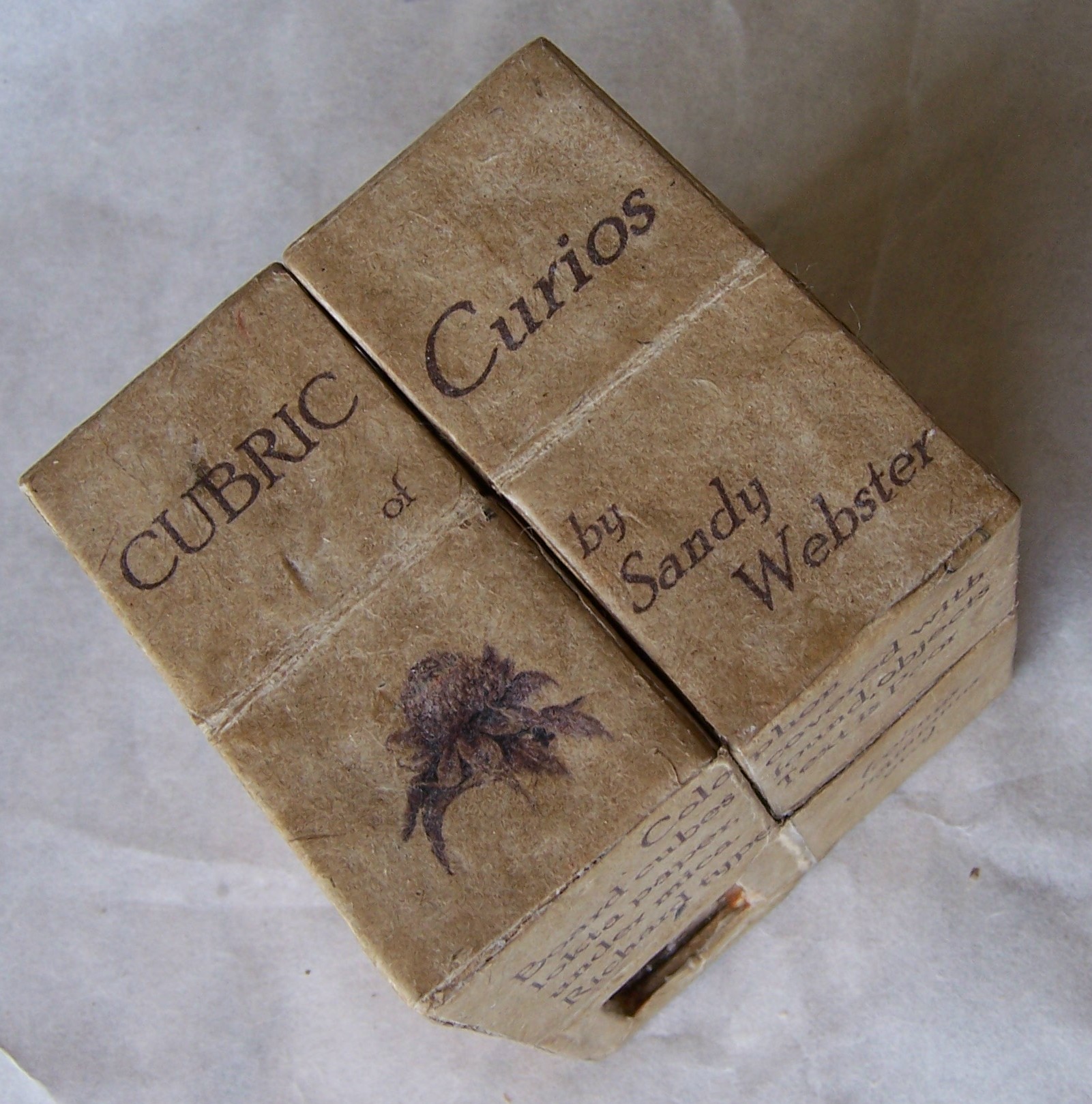
I talked about this one. The shear joy of flipping it open in sequence, reading the text and peering into the mica covered windows at small curiosities.

Cubric of Curios No 3 closed   Cubric of Curios No 3 Personal collections

And this one. A scroll book in a box that maps out a daily walk and measures twelve feet in length. Each stitch in the hand sewn line being the equivalent of ten steps. It is housed in a box marked by the soils and objects picked up along the way and full of small watercolors of what I saw along the walk.

Take a Walk with Me box scroll rocks
image-1348


Take a Walk with Me end to beginning open
image-1349

I showed them sketchbooks and we talked about calligraphy. They asked what I thought about calligraphy and I was honest. I don’t much care for the practiced craft of calligraphy. The text becomes too much about how it was put on the page and not what the message is. I told them that whenever I see calligraphy done as it usually is, I feel I have received an invitation to a wedding that I really do not want to go to. It is a personal reaction to all that labor of making letters. And I further said that when I do see the craftsman of calligraphy attempting to make it “artful”, it seems forced. There are few that can move the marks of calligraphy past its own intention of looking lovely. And while I was at it, I added that I thought that too many calligraphers use other peoples writings and it would be good if they could simply come up a few of their own original words and not rely on those of others to make their work interesting.

folios
image-1350

I didn’t show them this piece from a series called “Folios”. It is my own not so great writing on the left, fragments from journals. And on the right a visual interpretation of some of the message. And of course colored with natural pigments. I suppose for me the work I am looking at just needs to be interesting more than it needs to be correctly and laboriously done.

Lost Volumes I II III
image-1351

And I showed them this. A series of three box/books using the text in fragments from an old romance novel to make out a sentence that the viewer can read by following the large marble clunk its way through the maze, bumping off walls toward the finish reading words in a sentence bemoaning “loss”.

Proust Pulley
image-1352

And finally I told them about this one. The Proust Pulley. The cut out text, likely from the same romance novel continually flows like Proust’s words themselves. One wonders whether his sentences will ever end. Pasted along the tensioned ribbon it says the following, “I suffer the worst withdrawal that might follow a result of repetition my daydreams have achieved that few small triumphs have tarnished from the trap of self-fulfilling fantasy.”

It doesn’t make much sense but it has the same “woefulness” of the maze books about loss.

I took between fifteen and twenty books with me and left about twice that many home that related to their studies this week about containment. I enjoyed meeting the students and was most appreciative of their interest in my work. But best of all was telling the stories behind each piece and remembering why it was so important for me to make a book about it.